
Math Monday: A Strong Start to the School Year
It’s Back to School season! Here are four ways to start strong, from day-one community building to routines you'll lean on all year.
Ideas for Day 1
Before you get to linear equations, get students talking. The first day sets the tone for how your class will discuss money and math all semester.
Here are some ready-to-go icebreakers that tie community building and personal finance together:
- Icebreaker: FinLit Bingo. Students circulate for 15–20 minutes, collecting initials from classmates whose financial experiences match the tiles.
- Icebreaker: 15-Point Pickup. Students form different groups to answer bold financial questions and collect 15 points.
- Icebreaker: Would You Rather…? Twenty scenarios that force a choice, like would you rather have no TV subscriptions or no music subscriptions? Try out one of the 4 facilitation suggestions.
- Icebreaker: Rapid-Fire Finance Face-Off. A fast-paced partner activity where students swap stories and explore how values and emotions shape money decisions.
- MOVE: Your Money Values. A classic 4-corners activity full of prompts that are sure to generate discussion. Note: This activity is not used in the Financial Algebra course, so no need to worry about repeating!
- PLAY: The Bean Game. Get your Smarties, M&Ms, or beans ready! Both a teacher and student favorite, this game helps students discover how personal experiences and values affect budgeting decisions. Note: This activity is not used in the Financial Algebra course, so no need to worry about repeating!
Give the Diagnostic
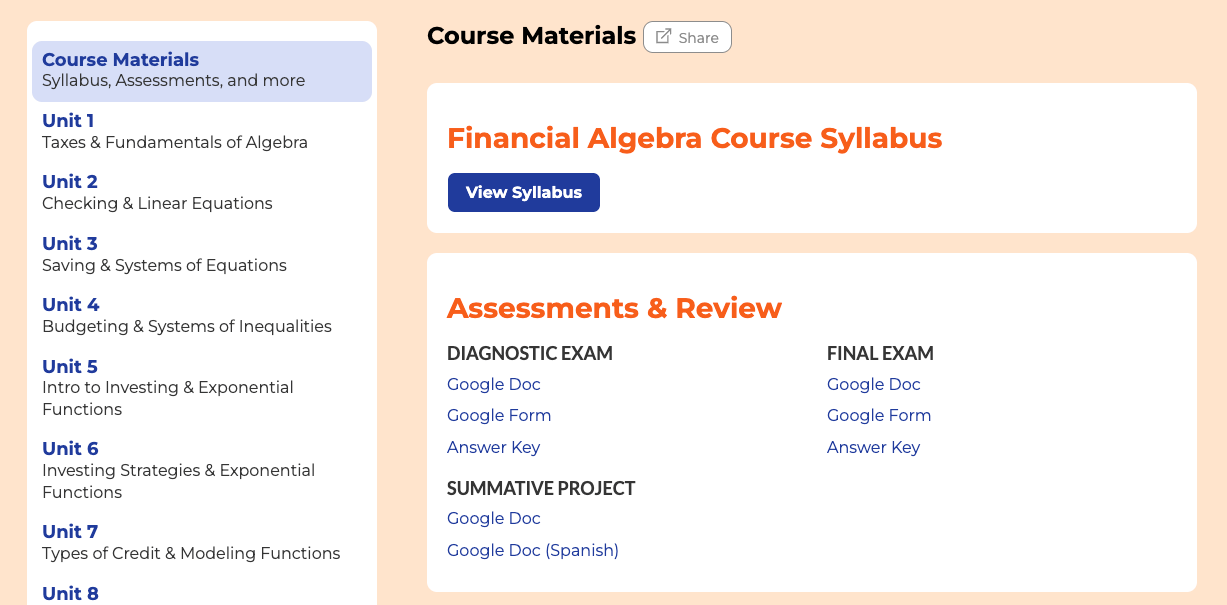
The Financial Algebra Course includes a diagnostic exam and a final exam, both on the Course Materials page. The exams test the same content on a question-by-question basis, so it will be easy to see what students know and how they’ve grown.
Each exam includes:
- Part 1: Twenty multiple-choice questions on personal finance content
- Part 2: Ten multiple-choice questions on math from across the course
- Part 3: Five open-response math questions
- A matrix in the answer key mapping every question to its unit
Available formats:
- An editable Google Doc version
- A Google Form version for automated grading of the multiple-choice sections
- An answer key, available when logged into a verified NGPF teacher account
Create a Mathematician of the Week Routine
Use the pre-built Math in Action Slide Deck to set up a weekly routine. It includes 60 profiles of mathematicians, each with a photo, a short biography, a resource to learn more, and discussion questions.
The deck spans mathematicians who have been historically and systemically excluded from the field. Setting up a weekly routine can be a small way to help students encounter mathematicians of all identities, see themselves reflected in mathematics, and expand their understanding of the field. It's a low-effort way to widen what "being a math person" looks like.
Want to customize it? Click File > Make a Copy.

Set Up a Reusable Unit Review Routine
Make life easier for yourself as the school year progresses! Here are 2 ideas for repeatable end-of-unit routines.
Option 1: Build Towards a Summative Project
Find CREATE: My Financial Flipbook listed as the "Summative Project" under Course Materials.
It's designed as an end-of-course project, but it's built to be completed unit by unit. Students record their biggest takeaways from each unit:
- #UNIT TIP — A tip you learned that you want to remember in the future
- DO THIS — General best practices to manage your finances
- GOALS — What are your financial goals? When do you want to reach them?
- INSPIRATION — Quotes, images, etc. that motivate you to reach your personal finance goals
- REFLECT — What questions can you ask yourself regularly to make sure your finances reflect your values and goals?
For a math class, add a sixth prompt: one math skill from this unit and where you'd use it.
By December, students will have built a personal reference document they can carry into their financial lives. Here are 10 creative ways teachers use My Financial Flipbook for more implementation ideas.

Option 2: Go back for the Application levels you skipped
The Financial Algebra Course includes Applications with every math-focused lesson. Because these Applications include 3 levels of problem sets, there’s a lot of content to pull from.
At the start of the year, come up with a plan for how you’ll use Applications. Many teachers assign one level at the end of a lesson, which leaves 2 levels empty. Consider revisiting those leftover Application levels at the end of the unit for review.
NGPF is excited to accompany you in a new school year - we hope it's a great one!
 PREVIOUS POST
About the Author
Kathryn Dawson
Kathryn (she/her) is excited to join the NGPF team after 9 years of experience in education as a mentor, tutor, and special education teacher. She is a graduate of Cornell University with a degree in policy analysis and management and has a master's degree in education from Brooklyn College. Kathryn is looking forward to bringing her passion for accessibility and educational justice into curriculum design at NGPF. During her free time, Kathryn loves embarking on cooking projects, walking around her Seattle neighborhood with her dog, or lounging in a hammock with a book.
 More posts
by Kathryn
More posts
by Kathryn 

Subscribe to the blog
Join the more than 12,000 teachers who get the NGPF daily blog delivered to their inbox:
SIGN UPMOST POPULAR POSTS


