
Yes, Students Can Take Both Financial Algebra and Personal Finance!
Teaching Financial Algebra to students who also take NGPF’s Semester Course? Here’s what you need to know, plus a quick reference for where the two courses overlap.
The good news: students can take both the Financial Algebra Course and the Semester Course. They will see familiar topics, as they reinforce key personal finance objectives through a different lens.
Can students take both courses?
Yes! Plenty of schools already offer both courses. The courses share some content, but are built for different purposes: Financial Algebra is a math course that uses personal finance as its real-world context, while the Semester Course takes a deeper dive into personal finance.
When possible, we recommend that students take the two courses at different times. Of course, scheduling looks different at every school, and students can take both courses in the same year.
How similar are the courses?
At a high level, the Financial Algebra Course covers 8 of the 11 units in NGPF’s Semester Course, so students will see familiar topics. However, the Financial Algebra Course adds a math lens and goes into less depth on personal finance topics than the Semester Course.
For students, this should feel more like a helpful review than a repeat. They’ll recognize some concepts and activities, then build on them with new data, real-world scenarios, and math.
What are the differences between the 2 courses?
While the courses share some topics, they look and feel different in the classroom.
- The Financial Algebra Course is a year-long math course designed for students earning a third or fourth math credit. Each of its 10 units pairs a personal finance topic with a math skill, like Investing & Exponential Functions or Insurance & Probability.
- The Semester Course is NGPF’s flagship personal finance course. It covers all 11 units and goes into more depth on personal finance content. It includes 3 units not in the Financial Algebra Course: Behavioral Economics/ Making Money Decisions, Career, and Consumer Skills.
Financial Algebra blends math and personal finance through two types of lessons:
- Personal finance lessons with a math connection: Students learn personal finance content, then apply it in a Math Connection.
- Math lessons with a personal finance application: Students build an algebra or statistics skill, then use it to solve a real-world personal finance problem in an Application.
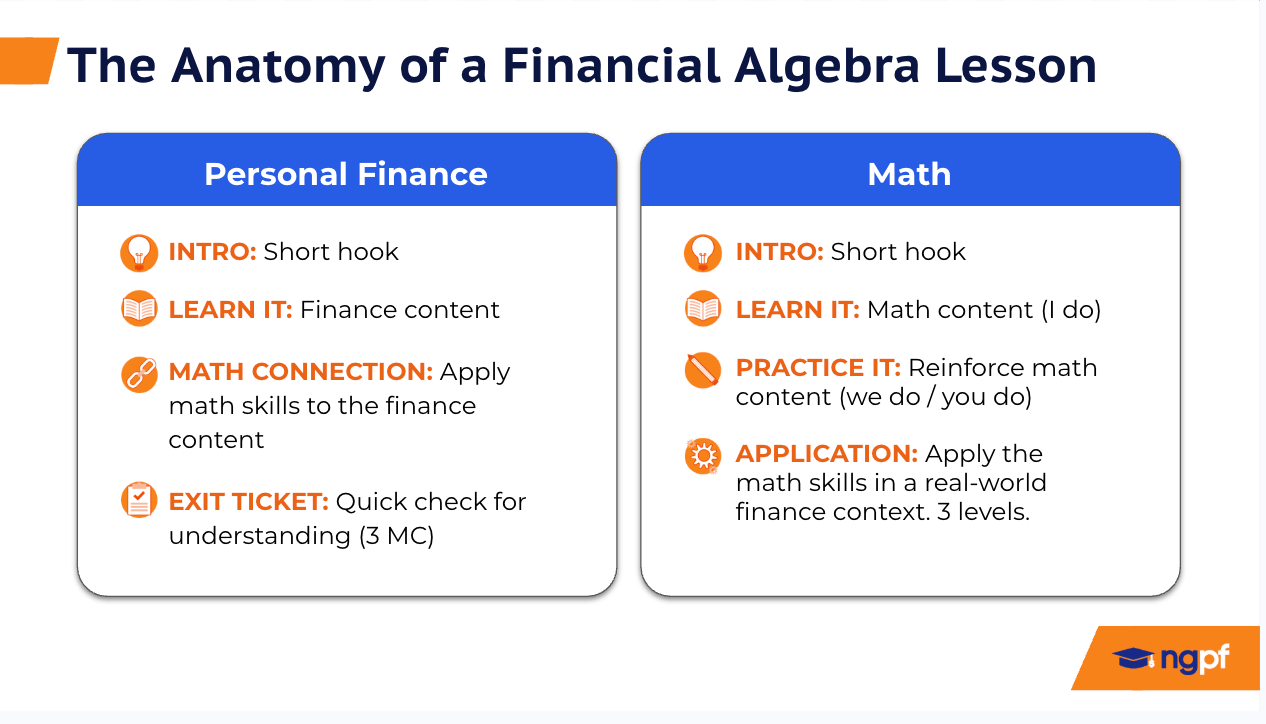
Even when the topic is the same, Financial Algebra lessons often use different readings, data, and tasks than their Semester Course counterparts. Math lessons, Math Connections, Applications, and Amplify Classroom activities are all unique to Financial Algebra.
Where do the courses overlap the most?
The overlap between the two courses reinforces the most important personal finance topics and prioritizes NGPF’s most popular, high-engagement activities. That’s by design: these are student favorites!
These are activities used in both the Financial Algebra and Semester Course, in case you would like to customize your course to minimize overlap.
- MOVE: Your Tax Dollar in Action (FA-1.1 Fractions & Tax Dollars)
- FINE PRINT: Checking Account Statement (FA-2.1 How Checking Works)
- ANALYZE: Overdraft Fees (FA-2.2 Beware of Banking Fees)
- DATA CRUNCH: How Do Consumers Use Mobile Banking? (FA-2.6 Online and Mobile Banking)
- INTERACTIVE: Online Bank Simulator (FA-2.6 Online and Mobile Banking)
- CREATE: Your Savings Goals (FA-3.1 Why Save?)
- INTERACTIVE: Living Paycheck to Paycheck (FA-3.5 Challenges to Saving)
- COMPARE: Types of Saving Accounts (FA-3.9 Where to Save)
- MOVE: Let’s Make a Mutual Fund (FA-6.1 Investing in Funds)
- INTERACTIVE: Invest with STAX! (FA-6.5 Develop an Investing Strategy)
- ANALYZE: Dollar Cost Averaging (FA-6.5 Develop an Investing Strategy)
- MOVE: Credit Musical Chairs (FA-7.1 Credit Basics)
- CALCULATE: The Cost of Auto Loans (FA-7.3 Auto Loans and Mortgages)
- DATA CRUNCH: What’s the Distribution of Federal Student Loan Debt in the U.S.? (FA-7.4 Student Loans)
- COMPARE: Which Repayment Plan Fits Your Income? (FA-7.4 Student Loans)
- FINE PRINT: Schumer Box (FA-7.7 Credit Cards)
- INTERACTIVE: Compounding Cat Insanity (FA-8.1 Managing Debt)
- CALCULATE: Impact of Credit Score on Loans (FA-8.6 Why Your Credit Score Matters)
- ANALYZE: A FAFSA Submission Summary (FA-9.4 Applying for the FAFSA)
- FINE PRINT: Financial Aid Package (FA-9.7 Financial Aid Packages)
- MOVE: What Determines Your Insurance Premium? (FA-10.3 Intro to Insurance)
- PLAY: Types of Car Insurance (FA-10.5 Auto Insurance)
- COMPARE: Types of Health Insurance Plans (FA-10.7 Health Insurance)
- INTERACTIVE: Bummer! (FA-10.8 Other Types of Insurance)
- DATA CRUNCH: How Do Renters and Homeowners Insurance Compare? (FA-10.8 Other Types of Insurance)
These Financial Algebra lessons share the most personal finance content with a Semester Course lesson. If you’re short on time, you might move quickly through the personal finance content and spend more time on the Math Connection.
- FA-2.2 Beware of Banking Fees | SC: Beware of Banking Fees
- FA-2.6 Online and Mobile Banking | SC: Online and Mobile Banking
- FA-4.3 Budgeting Strategies | SC: Budgeting Strategies
- FA-5.4 Stocks | SC: What is the Stock Market?
- FA-6.1 Investing in Funds | SC: Investing in Funds
- FA-9.7 Financial Aid Packages | SC: Financial Aid Packages
- FA-10.3 Intro to Insurance | SC: Intro to Insurance
- FA-10.5 Auto Insurance | SC: Auto Insurance
I saw the Semester Course will be updated in November. Does this guidance still apply?
Yes! On November 12, NGPF is launching an updated Semester Course. It’s the same course you know, refined rather than rewritten. Every lesson is built for a 45-minute class period, the 11 units stay in the same order, and most lessons and activities carry over. The Classic Semester Course will stay available through the end of this school year.
All of the guidance above still applies. In fact, the updated Semester Course has slightly less overlap with Financial Algebra, in terms of activities and lesson resources.
Here is the list of shared activities between the Financial Algebra Course and the updated Semester Course.
- MOVE: Your Tax Dollar in Action (FA-1.1 Fractions & Tax Dollars)
- FINE PRINT: Checking Account Statement (FA-2.1 How Checking Works)
- ANALYZE: Overdraft Fees (FA-2.2 Beware of Banking Fees)
- INTERACTIVE: Online Bank Simulator (FA-2.6 Online and Mobile Banking)
- CREATE: Your Savings Goals (FA-3.1 Why Save?)
- INTERACTIVE: Living Paycheck to Paycheck (FA-3.5 Challenges to Saving)
- COMPARE: Types of Saving Accounts (FA-3.9 Where to Save)
- PLAY: Roll with the Market (FA-5.6 Bonds, Allocation, and Diversification)
- MOVE: Let’s Make a Mutual Fund (FA-6.1 Investing in Funds)
- INTERACTIVE: Invest with STAX! (FA-6.5 Develop an Investing Strategy)
- MOVE: Credit Musical Chairs (FA-7.1 Credit Basics)
- CALCULATE: The Cost of Auto Loans (FA-7.3 Auto Loans and Mortgages)
- COMPARE: Which Repayment Plan Fits Your Income? (FA-7.4 Student Loans)
- FINE PRINT: Schumer Box (FA-7.7 Credit Cards)
- INTERACTIVE: Compounding Cat Insanity (FA-8.1 Managing Debt)
- CALCULATE: Impact of Credit Score on Loans (FA-8.6 Why Your Credit Score Matters)
- ANALYZE: A FAFSA Submission Summary (FA-9.4 Applying for the FAFSA)
- FINE PRINT: Financial Aid Package (FA-9.7 Financial Aid Packages)
- PLAY: Types of Car Insurance (FA-10.5 Auto Insurance)
- COMPARE: Types of Health Insurance Plans (FA-10.7 Health Insurance)
- INTERACTIVE: Bummer! (FA-10.8 Other Types of Insurance)
Learn More
 PREVIOUS POST
About the Author
Kathryn Dawson
Kathryn (she/her) is excited to join the NGPF team after 9 years of experience in education as a mentor, tutor, and special education teacher. She is a graduate of Cornell University with a degree in policy analysis and management and has a master's degree in education from Brooklyn College. Kathryn is looking forward to bringing her passion for accessibility and educational justice into curriculum design at NGPF. During her free time, Kathryn loves embarking on cooking projects, walking around her Seattle neighborhood with her dog, or lounging in a hammock with a book.
 More posts
by Kathryn


Subscribe to the blog
Join the more than 12,000 teachers who get the NGPF daily blog delivered to their inbox:
SIGN UPMOST POPULAR POSTS


